Whether in matters of business, governance or ecclesiastical organization, what distinguishes winners from losers? And how do winners remain relevant through times of internal and external conflict?
Organizational Roles & Personalities
Six distinct phases of organization can be defined as applicable — whether in matters of business, governance or religion, each requiring distinct roles not just to survive, but thrive. Phase-specific predominant roles are those of the:
Visionary — the dreamer who sets the process of change in motion. Think Steve Jobs or, more recently, Elon Musk.
Initiator — the innovator who defines the potential market or audience as investors and customers — and how to reach them.
Marketer — those that test the concept and product n the real world — the missionary.
Organizer — who elevates product and customer delivery — from fringe to mainstream market acceptance.
Manager — responsible to maintain market leadership — ahead of all competitors.
Reformer — recognizing slippage of market dominance — defining the need for course correction, even radical change.
Ecclesiastical Application
With the remainder of this blog post, I propose to apply this conceptual framework to one of the longer-term examples starting with paradigm identification and progressing to market dominance — in this case to the history of and adaptation of Christianity over a 1,500+ year time period. Diagrammatically, these six phases can be illustrated as follows:
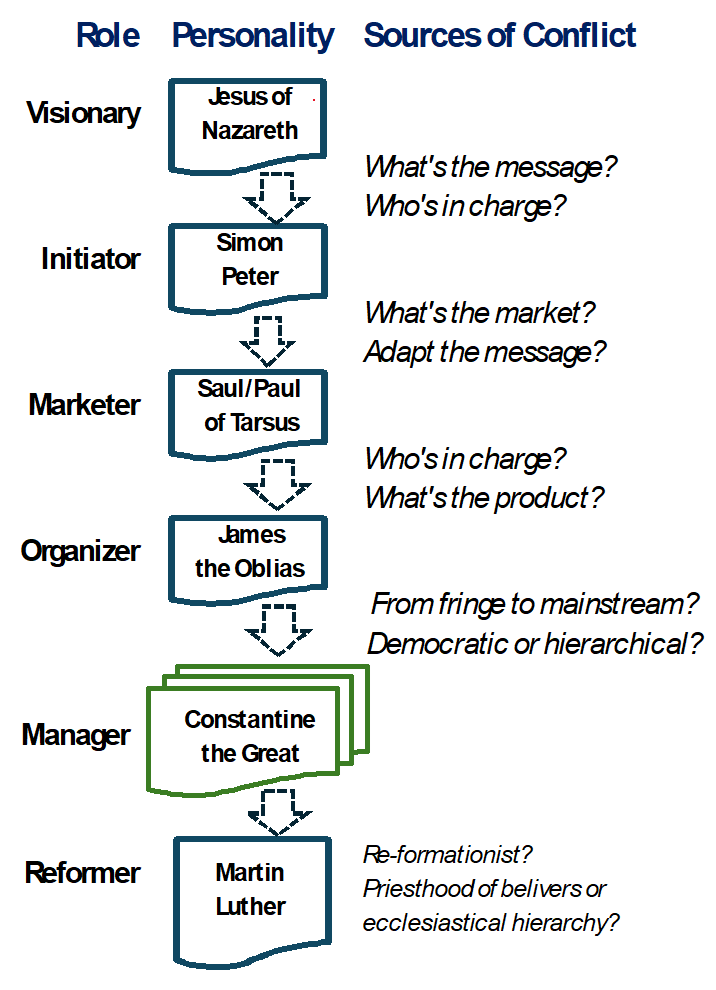
As depicted by four New Testament gospel writers, Jesus of Nazareth is the visionary. In broad and illustrative strokes, he defines what the kingdom of God is about — both in this temporal world and beyond to eternity. In articulating this vision, he finds himself in conflict with the religious and political leaders of the day — leading to his execution.
Subsequent to Jesus’ reported death, resurrection and ascendance, a former fisherman named Simon Peter is thrust into leadership of a nascent Christian movement. As initiator, he defines the message to a diverse audience — the need for repentance and for a new way of communal life.
After persecuting early Christians, Saul (renamed Paul) of Tarsus emerges as God’s chosen marketer of the message more broadly to a Greco-Roman world extending far beyond the confines of Jewish Judea and the Galilee. This places him in direct conflict with Peter and Jesus’ stepbrother James the Oblias (aka “bulwark of the people”) challenging what the Christian message is really about and who’s in charge.
Due to concerns over Peter’s periodic rash behavior, James emerges to become the titular leader and organizer of the mother church at Jerusalem. He will question Paul’s formulation of salvation by faith alone with his alternative view of the good Christian life via good works, living out Jesus’ command to love one’s neighbor. But he also sets Paul largely free to lead an extensive missionary outreach to present day Turkey, Greece and finally Rome.
Over the next three centuries and despite periodic persecution, the Christian movement flourishes with diffuse leadership coupled with market-driven theological diversity. Roman emperor Constantine converts to Christianity cementing the transition from fringe to mainstream. To maintain his grip as sole emperor, he quickly perceives a need to also become manager of the new imperial religion, dictating what was to become the Nicene Creed as the touchstone for ensuing Christian doctrine and practice.
After more than a millennium of hierarchical church leadership and despite chaotic civilization of the dark ages, a German monk named Martin Luther emerges as lead reformer of Christian faith and practice. Despite advocacy for a priesthood of believers, Luther’s distaste for civil unrest and spin-off denominations leads him to recreate a separate ecclesiastical hierarchy to counter that of Rome and Constantinople.
Where to From Here?
Luther’s re-formationist initiative arguably helped to create the diverse cultural and political market-driven enlightenment and renaissance that has unfolded over the last half-millennium. His early use of the recently invented printing press is the precursor to the mass media market of the 21st century. And despite his own misgivings and rash judgments, religious diversity has flourished in the centuries that have followed.
The counterargument is that Luther represents a re-formation still undone. The proliferation of Christian denominations and more recently independent church congregations as with megachurches remains challenged to effectively communicate a collaborative message that resonates beyond ecclesiastical walls. And a need to advocate effectively for a more just, equitable, prosperous human-centered world amid the challenging and changing realities of this 21st AI-led century.
Last year’s closure of the 355 year old Hudson’s Bay Company illustrates the reality that longevity alone is no guarantee of future on-going organizational viability. Similarly, today’s church needs to experience renewed vitality by playing to its strengths of unity of purpose coupled with diversity of practice and cultural relevance.
Bottom line, there is still the opportunity to again re-define the product and the market, better achieving Jesus of Nazareth’s vision for unfolding more of the kingdom of God here on earth.
This blog post has been prepared by Eric D. Hovee based on research from his book “Conflict & Peace: At Home with Jesus.”